

Learning, Growing, and Full Circle Moments
Recognizing sandpipers and internal growth through Wildlife Tracking

Dear friends,
Every year, I notice more details as the seasons shift, and become more familiar with my internal shifts as a tracker and guide. Keep reading to hear about one vivid realization of progress, and how to support your growth in tracking or other practices.
As summer fades to mellow fall here in Minnesota, I’m looking forward to teaching the following classes. Come out and explore the rhythm of the seasons with me:
Saturday, September 20, 1-5 PM: Wilderness Wisdom: Exploring Nature’s Bounty and Animal Secrets [Register here.] If you’re curious about tracking and foraging, this will be an excellent introduction. I’ll be co-teaching this class with fellow tracker and expert forager Maria Wesserle.
Thursday, October 2, 6-8 PM: Walking with the Woods. [Register here.] This will be the first walk of this season bridging light and dark. Come experience sunset and the quiet dark of Hidden Falls Regional Park.
Sunday, October 12, 9 AM-12 PM: The Secret Lives of Deer. [Register here.] We’ll follow trails of white-tailed deer, debrief their sign and tracks, and explore their natural history through tracking — while keeping our eyes up for a view of these elusive cervids.
Full Circle with Sandpipers
We’re always learning and growing, even if we don’t recognize this progress every day. Occasionally, we might get a flash of progress that shows us how far we’ve come, and inspires us to keep walking forward. Last month, I experienced one full circle moment: I might not be certified as a Professional in Track & Sign yet, but I’ve come a long way from where I began.
In May 2016, I took my first CyberTracker Track & Sign Certification with Nate Harvey. Midway through the first day, we were shown bird tracks circled on a mud flat. Each was tiny — roughly the length of the last digit of my thumb (~1”). Three straight, slender toes radiated from a central point, with the barest dot behind their apex. “Q28: Who?” asked the popsicle stick.
I had no idea. In the past 10 questions — also all bird tracks! — I had completely exhausted my known options of heron, egret, and robin. When I turned in my answers, #28 was blank. Nate approached me shortly after: “Do you want to turn in an answer for #28? You don’t have a chance to get it right if you don’t submit an answer.” “Um… OK. Sandpiper?” “Great. Can you be more specific?” Embarrassed, I whispered: “…Nate, I don’t know any sandpipers.”
#28 was the trail of a spotted sandpiper (track illustration) — an adorable and common resident of our northern states riverbanks during their breeding season.
+++
Last month, nine years later, I took another certification with Nate, this time in Vermont. As we waded through the Lamoille River onto the sandbar, here were the first two questions that greeted us:
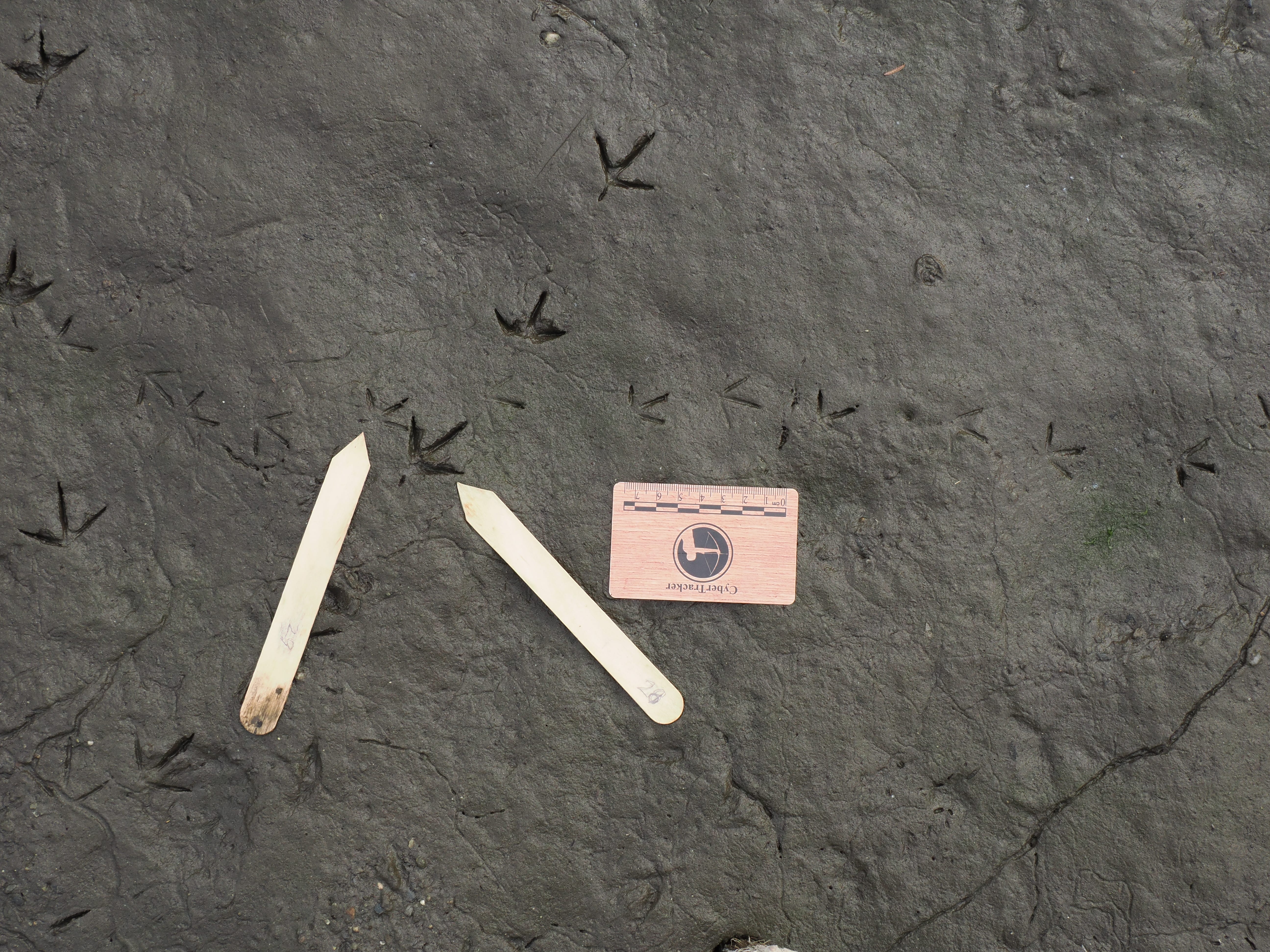
When those tracks registered in my sight, my mind piped right up: “Hey, sandpipers! But #29 is too small for a spotted — is that a semipalmated or least sandpiper? Cool! Those are more rare. And #28 is a bit large for spotted. I’ve seen solitary sandpiper further north in summer, and they migrate about this time of year. I bet that’s one of them.”
Not only did I nail the family and species, #28 was a bonus question — specialized knowledge above and beyond what is expected for a Professional certificate in Track & Sign. Not bad for someone who didn’t know any sandpipers nine years ago!
+++
If you’re interested in learning an experiential practice like this, but don’t know where to begin — start here.
1. Find a welcoming community for practice. Without the Minnesota Wildlife Tracking Project monthly tracking gatherings, I would not have developed my tracking skills. In 2013, going into the woods to poke around on my own felt like a lonely, unhelpful, and possibly dangerous proposition. Going out monthly with a group of warm, friendly folks with decades of expertise and honest awareness of their limits of knowledge was vital to my development. They welcomed my questions, supported my inquiry, and helped me see tracks and sign that I would have wandered past without recognition — and laid the foundations for my future studies and explorations. I have become who I am thanks to that core community: Jon, Donnie, Marty, Rob, Brian, and Amy.
2. Find a skilled, supportive teacher to guide your practice and identify your gaps. Skilled teachers can inspire us through their example, point us to new sources for learning, and show us our blind spots (like bird tracks!). Thank you, Nate Harvey, for seeing my desire to learn this practice in 2016, naming how I contributed to the community as a beginner, and treating me with kindness and dignity.
3. Follow your curiosity and keep learning. One of our local trackers is a phenomenal birder and will drive three hours to observe a rare bird; another follows his deep, lifelong interest in movement to unravel how different animals move and interpret their track patterns to help all of us “see” the animal in motion. Right now, I’m fascinated by plaster casts and distinguishing jumping mouse from vole tracks; my long-term interest is how different diets processed through an animal’s digestive system produce wildly different forms of scat. Whatever calls your attention and fires your curiosity — explore that!
4. Share what you have learned with friends who welcome your enthusiasm. As I read up about animal diets, and correlate that to the sign I see in the field, I periodically ask tracker friends over for dinner. It’s potluck for both the body and mind — we each bring something to share for dinner, as well as something to share that we’ve studied. That might be a summary of life history of porcupines, videos of domestic dogs in different gaits, plaster casts that show the tiny ridges of vole toes, or a new chocolate-raspberry dessert recipe that happens to look exactly like red fox scat. And at the end of the evening, we part with greater knowledge and appreciation of nature, curiosity, and joy.
5. Keep it fun. If you don’t enjoy the practice, you won’t stick with it. When my friend invited me to my first tracking club in October 2013, I knew nothing about tracks — but I knew my friend wouldn’t make fun of me for not knowing. During each monthly gathering, I learned so much by listening to more experienced trackers and asking questions — and I always felt happier and more alive after three hours of wandering in the woods on a Sunday morning. Even now, I remind myself: we do this for fun.
I continue to volunteer for MWTP events because I believe wholeheartedly in our community’s mission: share the art and science of wildlife tracking, and deepen our connections to ourselves, to others, and to the natural world. You are warmly invited to join us for the next MWTP Tracking Club on September 21. Details will be posted soon here.
+++
In the next newsletter, I’ll share what I learned from experimenting with a new, tactile way to approach tracks: plaster casting. I’m contemplating offering a wildlife tracking class which includes making your own plaster cast of a track to take home. If this fires your interest, please complete the poll.
With gratitude,
Kirsten
www.naturalawarenessguide.com